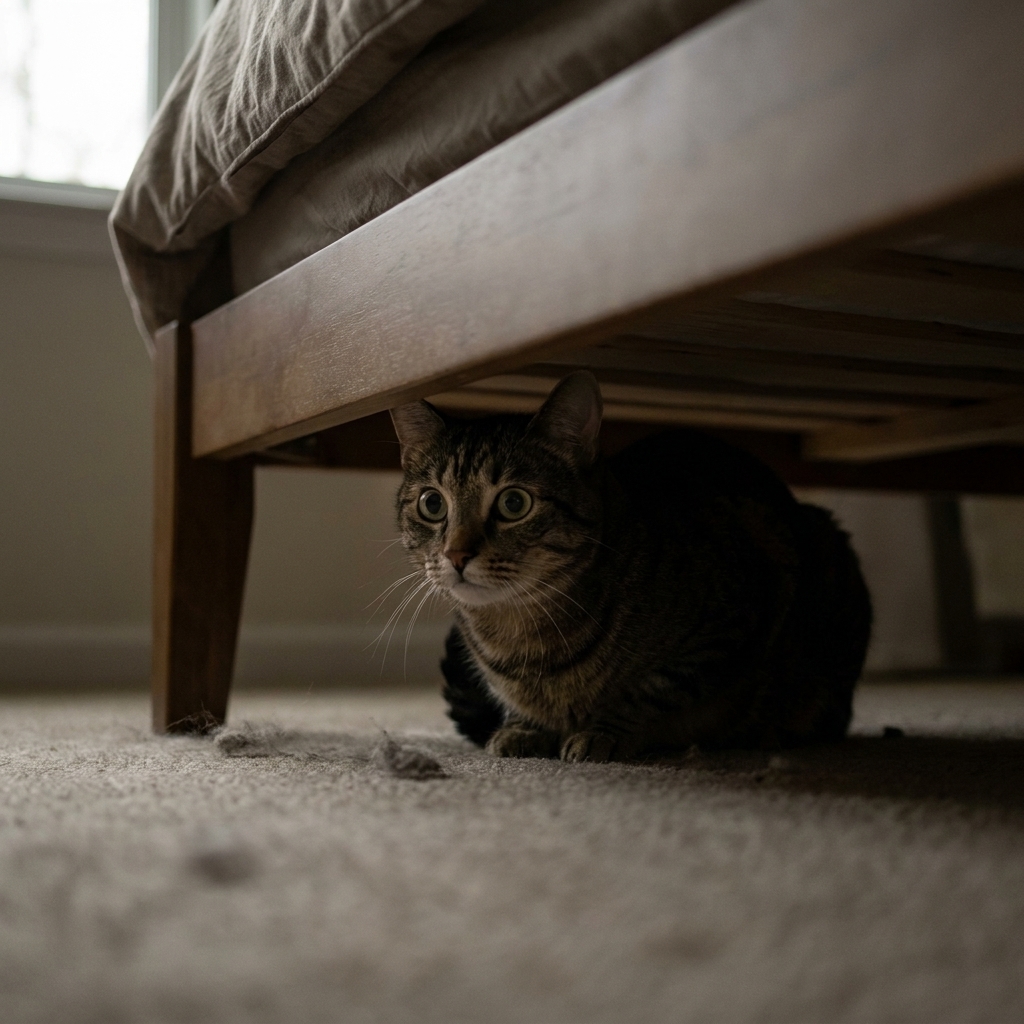
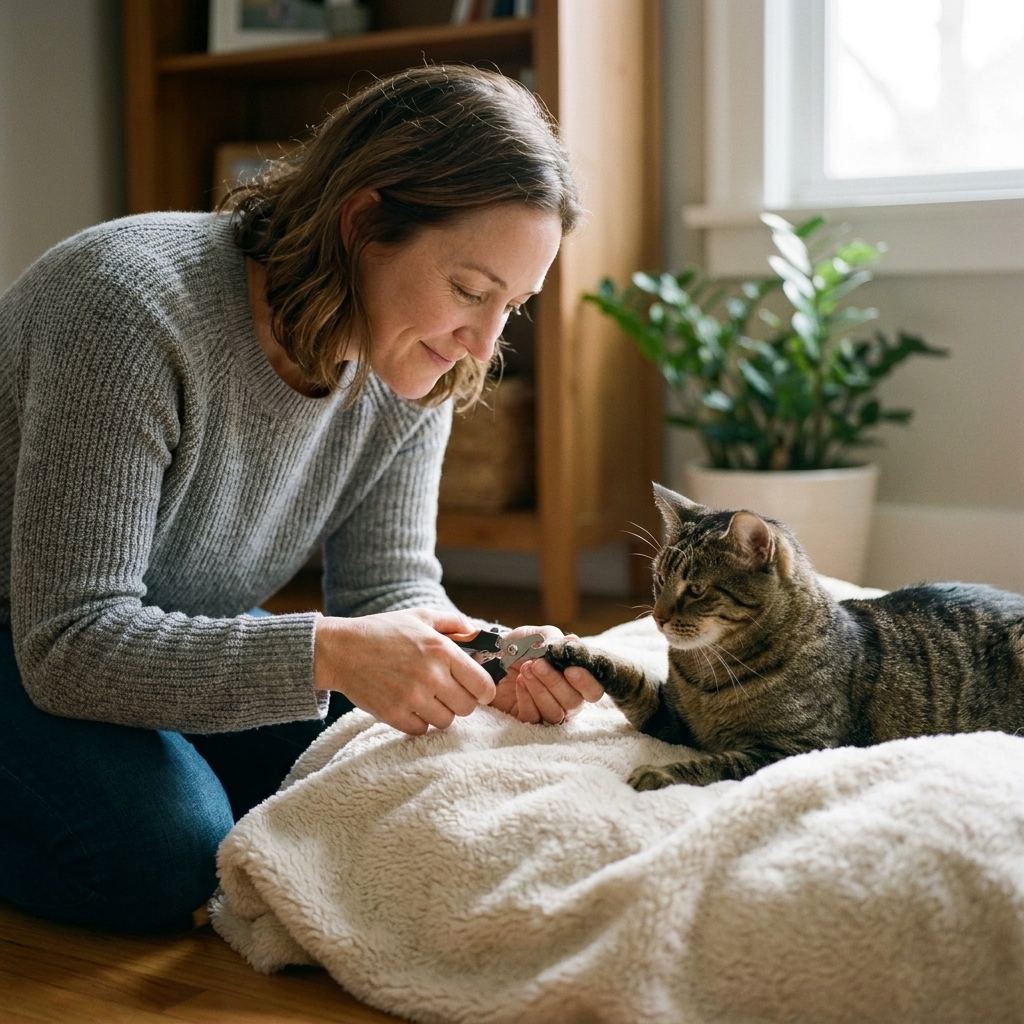
If you have ever opened your cat’s mouth for a peek and thought, “Oh no, that is not supposed to look like that,” you are not alone. Dental disease is very common in cats, and it can sneak up on even the most attentive cat parent. The good news is that brushing, when introduced gently, is one of the most effective at-home tools we have to slow plaque buildup and support healthier gums.
I have helped a lot of cats learn to tolerate tooth brushing, including former “spicy” rescue cats who wanted absolutely nothing to do with hands near their face. The secret is not force. It is tiny steps, great timing, and making the whole experience predictably safe.
Why brushing matters
Cats do not get cavities (tooth decay) as often as people do, but other oral problems are far more common, especially along the gumline. Plaque and tartar buildup can contribute to:
- Gingivitis (red, irritated gums)
- Periodontal disease (infection and damage to the structures supporting the teeth)
- Tooth resorption (painful lesions that can look like “holes” near the gumline)
- Bad breath that is more than just “cat food breath”
- Mouth pain that may show up as picky eating, dropping food, or hiding
Brushing does not replace professional cleanings when your cat needs them, and it will not remove hardened tartar (calculus) once it is stuck to the teeth. But it can meaningfully slow plaque buildup between vet visits, which helps protect gums where disease often starts.
Before you start
If your cat already has noticeable dental pain, brushing can be uncomfortable and may create a long-term aversion. Do a quick look and watch for red flags.
Pause and call your vet if you notice:
- Bleeding gums
- Swelling around the mouth or jaw
- Very bad breath that appeared suddenly
- Drooling, pawing at the mouth, or teeth grinding or chattering linked with discomfort
- Not chewing on one side, dropping kibble, or refusing hard food
- Brown, thick tartar covering multiple teeth
If your cat is due for a dental exam or cleaning, get that scheduled first. Brushing works best on teeth that are not already painfully inflamed, and conditions like resorption and advanced periodontal disease typically need veterinary treatment.
What you need
You do not need a whole “cat spa” setup. A few basics go a long way.
Must-haves
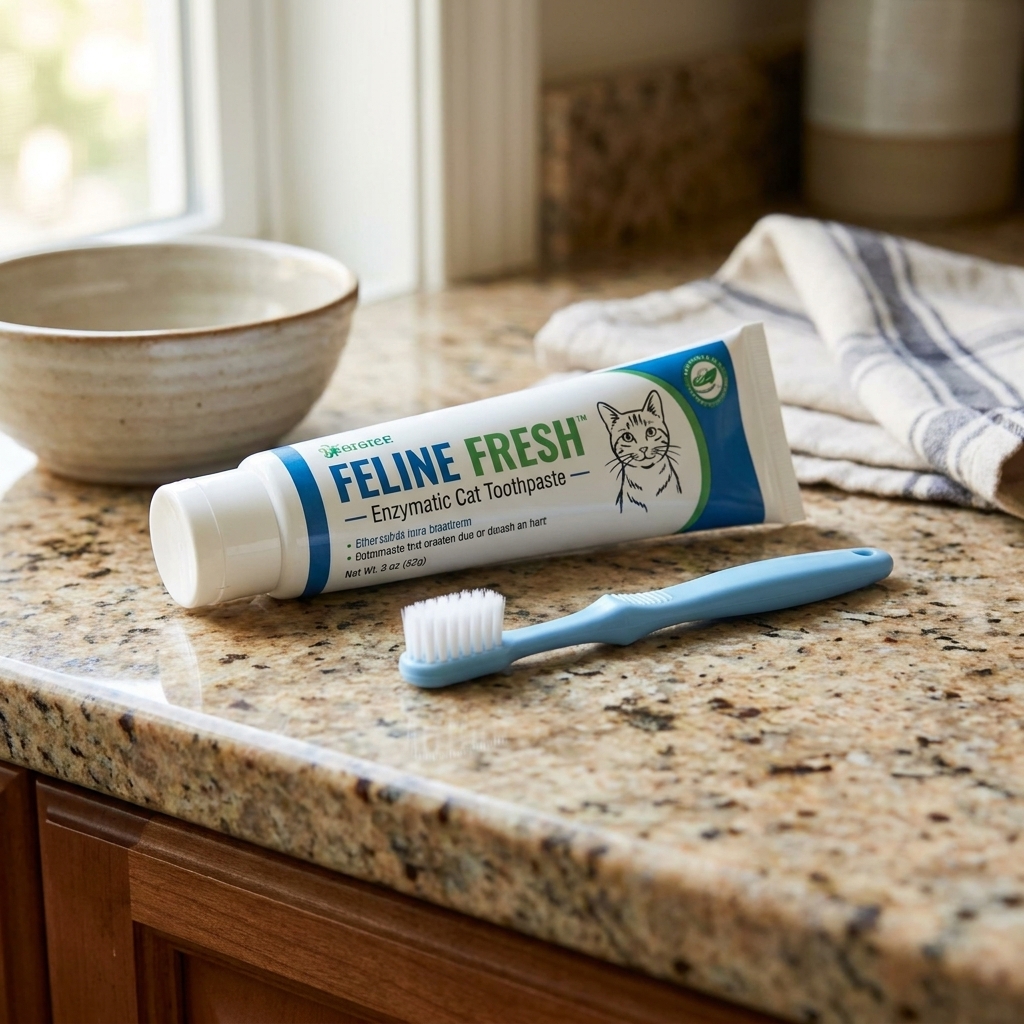
- Cat-safe toothpaste (enzymatic formulas are popular). Never use human toothpaste. Many contain ingredients that are unsafe for cats.
- A toothbrush option your cat tolerates: a soft cat toothbrush, a finger brush, or even a piece of gauze wrapped around your finger.
- High-value reward for after, like a lickable treat, a favorite snack, or a play session.
Nice-to-haves
- A small towel or non-slip mat for lap stability
- A second person for your first few sessions, only if your cat stays calmer with support
What not to do
- Do not scrape tartar with human dental tools. You can injure gums or chip teeth, and it does not address disease under the gumline.
- Do not use essential oils or DIY mouth mixes. Many are irritating or toxic to cats.
- Do not use chlorhexidine rinses unless your vet specifically tells you to. Some cats tolerate them poorly, and dosing and formulation matter.
- Never use xylitol-containing products. Keep any human oral care items out of reach.
Set up for success
Pick your moment
Choose a quiet, predictable spot where your cat already feels safe. I love a couch corner, a bed, or a favorite chair. Aim for a time when your cat is naturally relaxed, often after a meal or a play session.
Keep it short
For beginners, your goal is not “perfect brushing.” Your goal is repeatable brushing. Most cats do best with 10 to 30 seconds at first, building gradually.
Use one cue
Saying the same gentle phrase each time (like “teeth time”) can help your cat predict what is coming. Predictability lowers stress.
Step-by-step training
Think of this as a mini training plan. You only move to the next step when your cat is relaxed at the current one.
Step 1: Make mouth touches boring
While your cat is cuddly, lightly touch the cheek and lift the lip for one second. Then reward immediately.
- Do 3 to 5 repetitions, then stop.
- Repeat daily until your cat stays loose and calm.
Step 2: Make toothpaste a treat
Put a tiny smear of cat toothpaste on your finger and let your cat lick it. Reward and end the session. If your cat dislikes the flavor, try a different one. Cats have opinions.
Step 3: Rub the outer teeth with your finger
Smear a bit of toothpaste on your finger and gently rub the outer surface of the teeth, focusing on the gumline and the back molars. In many cats, a lot of plaque and tartar tends to accumulate on the cheek-side (outer) surfaces, so you do not need to pry the mouth wide open.
- Aim for 5 seconds total, then reward.
- Gradually increase to 10 to 15 seconds over a week or two.
Step 4: Switch to a brush
Once your cat accepts finger rubbing, switch to your tool of choice. Start with just 2 to 3 gentle strokes on one side, reward, and stop.
Step 5: Build a simple pattern
Many cats accept brushing better if you do the same pattern every time. Example:
- Right side back teeth near the gumline: 5 to 10 seconds
- Reward
- Left side back teeth near the gumline: 5 to 10 seconds
- Big reward and done

How to brush
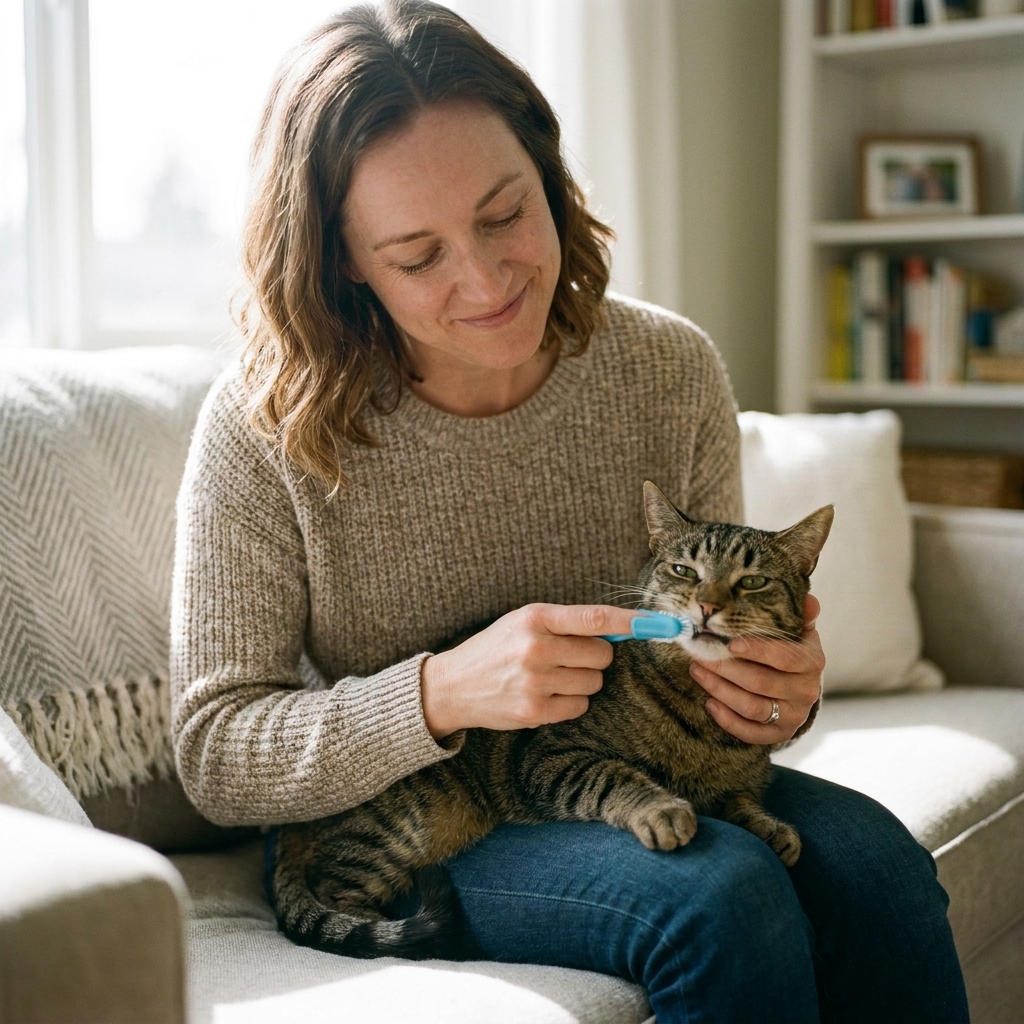
Once your cat is ready for “real brushing,” keep the technique simple. Your main target is the gumline, since that is where inflammation and periodontal disease often begin.
- Angle: Aim the bristles toward the gumline at about a 45-degree angle.
- Pressure: Use very light pressure. Think massage, not scrub.
- Motion: Small circles or short gentle strokes along the gumline.
- Focus area: Outer surfaces, especially the upper back teeth.
- Duration: Work up to 30 to 60 seconds total, if your cat will tolerate it.
If your cat will only let you brush a few teeth at first, that still counts. Consistency beats intensity.
And yes, toothpaste can help, but the brushing itself does the heavy lifting. If toothpaste is a dealbreaker, start with a damp brush or gauze and add toothpaste later.
How often to brush
Daily is ideal, especially for cats prone to tartar. If daily is not realistic, aim for at least 3 to 4 times per week. Plaque can start to mineralize into tartar in as little as about 1 to 3 days, which is why frequency matters. That said, any brushing is better than none.
If you are brand new, set a tiny goal: two short sessions this week. Then build from there.
Kittens and timing
If you have a kitten, this is one of those “future you will be grateful” habits. Gentle lip lifts and brief tooth touches during kittenhood can make adult brushing dramatically easier. Keep it playful, keep it quick, and stop while your kitten is still relaxed.
Keep it low-stress
My tortie Clementine wants to be in charge of everything, and my orange tabby Waffles is sweet but easily confused by new routines. What helps both of them is keeping tooth brushing predictable and generously rewarded.
- End on a win: Stop before your cat is over it.
- Reward every time: Brushing should reliably lead to something your cat loves.
- Skip the restraint: If you have to hold your cat down, you are going too fast.
- Stick to a routine: Same place, same time, same order.
Troubleshooting
“My cat clamps their mouth shut.”
Do not pry. Go back to lip lifts and finger rubbing on the outer teeth. Many cats will allow brushing without opening their mouth much at all.
“My cat runs away when they see the brush.”
Leave the toothbrush out near your supplies (out of chewing range) and reward your cat for approaching it. Then progress to touching the brush to the cheek for one second, reward, and stop. You are rebuilding the association.
“My cat bites the toothbrush.”
Some chewing is normal. Use a finger brush or gauze for more control, and keep strokes short. Reward calm behavior and take breaks.
“The gums bleed a little.”
A tiny bit of bleeding can happen with mild gingivitis, but persistent bleeding is not something to push through. Pause and schedule a veterinary dental exam to rule out painful disease.
“My cat hates the toothpaste.”
Try a different flavor or switch to a tiny dab of water at first while you build comfort with the brushing sensation. You can add toothpaste later.
If brushing is not possible
Some cats have a hard “no thank you” boundary around their mouths. If you cannot brush (or you are still training), these can help, especially when combined:
- Veterinary oral rinses or gels recommended by your vet
- Dental treats with VOHC acceptance when possible
- Dental diets with VOHC acceptance when possible
- Water additives made for cats, ideally VOHC-accepted, and introduced slowly
- Regular professional dental care based on your veterinarian’s guidance
If your cat has heart disease, kidney disease, asthma, or other chronic conditions, get veterinary input before adding new dental products.

Beginner plan
If you want a simple plan that does not feel overwhelming, try this:
Days 1 to 3
- One-second lip lift, reward, done.
- Repeat 3 times per session.
Days 4 to 7
- Let your cat lick toothpaste, reward, done.
- Add a quick lip lift if your cat is relaxed.
Week 2
- Finger rub outer teeth for 5 seconds, reward, done.
- Build toward 10 to 15 seconds.
Week 3 and beyond
- Introduce brush tool for 2 to 3 strokes, reward, done.
- Gradually brush one side, then the other.
Slow progress is still progress. The goal is a cat who feels safe, not a cat who “puts up with it.”
FAQ
Do I need to brush the inside of my cat’s teeth?
No. Much of the plaque accumulates on the outer surfaces near the gumline. If you can consistently brush the outside surfaces, especially the back teeth, you are doing the most important part.
Can I use baking soda or coconut oil instead of cat toothpaste?
I do not recommend DIY options. Cat toothpastes are formulated to be swallowed safely and to taste appealing to cats. If toothpaste is a barrier, start with a damp brush or gauze and add toothpaste later.
My cat’s breath is awful. Will brushing fix it?
Sometimes, but not always. Bad breath can be a sign of dental disease that needs veterinary treatment first. If the odor is strong, new, or paired with drooling or appetite changes, schedule an exam.
Is it too late to start brushing an adult cat’s teeth?
Not at all. Adult cats can learn new routines, especially when you move in small steps and keep sessions positive.
The take-home
Brushing your cat’s teeth is not about wrestling your way to a perfect two-minute scrub. It is about building trust, keeping it brief, and showing your cat that mouth handling predicts good things. Start small, celebrate tiny wins, and lean on your veterinary team if you see signs of pain, significant tartar, or anything that makes you suspect a bigger dental problem.
If you want to make this even easier, pick one cue phrase, one spot, and one reward, and keep that routine consistent for a month. Your future self, and your cat’s gums, will thank you.