The first time I had to pill a cat on my own, I was a kid in a foster bathroom with a spicy little tabby kitten and the absolute confidence of someone who had no idea what she was doing. The kitten disagreed. Loudly. If you are staring at a tiny tablet and a large cat-shaped opinion, I get it.
The good news is that many cats can learn to take medication at home safely when we use the right technique, stay calm, and keep the whole thing short and predictable. There are also exceptions. If your cat is highly fractious, painful, struggling to breathe, neurologic, or simply not safe to handle, it is not a personal failure to call your vet and ask for another plan. Below I will walk you through a gentle setup, two reliable ways to give tablets, how to give liquid medicine without a wrestling match, and what to do when the dose ends up on the floor anyway.
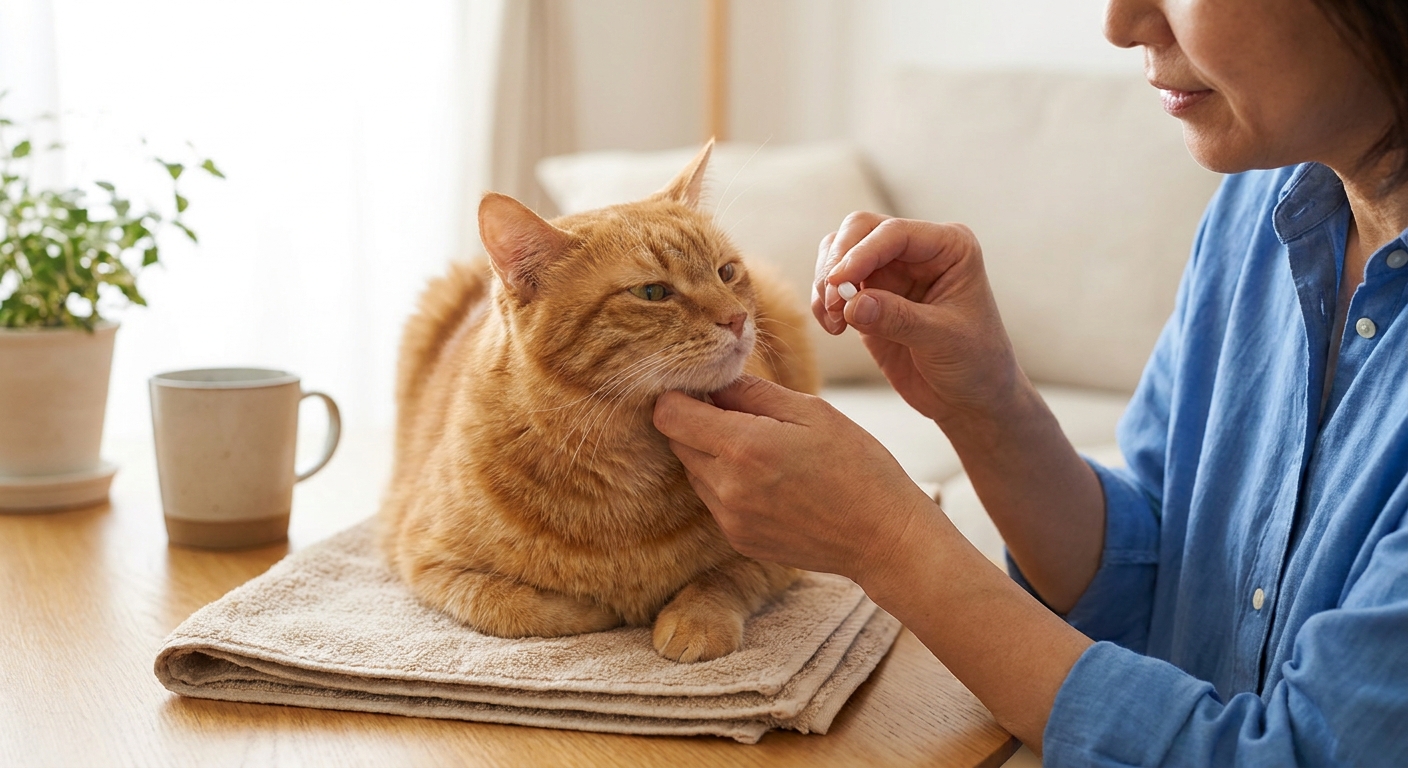
Before you start
1) Confirm the medication can be given this way
- Ask your vet or pharmacist if the pill can be crushed, split, or given with food. Some medications must be swallowed whole, and some are bitter enough to cause drooling and foaming if they dissolve in the mouth.
- Check timing: with food vs on an empty stomach. Many cats do better when a post-pill snack is allowed.
- Double-check the dose for the cat you are treating, especially if you have multiple cats. I like to say the cat’s name out loud before I medicate, every time.
2) Gather supplies and choose a small space
Having everything within arm’s reach prevents the classic mistake of letting go “for just a second.”
- The medication
- A few high-value treats or a spoon of wet food
- A towel or small blanket (for a wrap if needed)
- A pill giver (optional, but helpful for many people)
- For liquid meds: oral dosing syringe provided by your clinic
- A little water in a syringe (optional) if your vet says a small water chaser is appropriate
Pick a quiet room with a door and a non-slip surface like a rug or yoga mat. Bathrooms are popular for a reason: fewer hiding spots.
3) Keep it calm and quick
Speak softly, move slowly, and aim for “in and out.” Cats escalate when we hesitate. If you feel your nerves climbing, take a breath before you pick your cat up. Your cat can read you like a paperback.
Method 1: Hide a pill in food
Treat hiding can be a wonderful option for cats who are food-motivated and not suspicious of “tampered” snacks. It is also usually the least stressful approach.
When it is a good idea
- Your vet confirms the medication can be given with food
- The pill is small and not extremely bitter
- Your cat reliably eats a treat or a small portion of wet food in one sitting
How to do it and confirm the dose
- Offer a plain “test bite” first. This checks appetite and lowers suspicion.
- Hide the pill in a tiny amount of something very smelly and sticky, like a pea-sized ball of wet food. The portion should be small enough that your cat does not chew much.
- Follow with a second plain bite immediately. Many cats swallow faster when the next bite is coming.
- Verify the pill is not left behind. Check the bowl, the floor, and your cat’s immediate area.
If your cat chews and spits, refuses the food, or starts avoiding that treat entirely, stop trying to “outsmart” them. Cats are excellent detectives, and you do not want to create a long-term food aversion.
A quick safety note: keep your hiding food simple. Avoid anything with onion or garlic, and skip “sugar-free” or artificially sweetened foods. When in doubt, use your cat’s regular wet food, a commercial pill pocket, or a vet-approved treat.
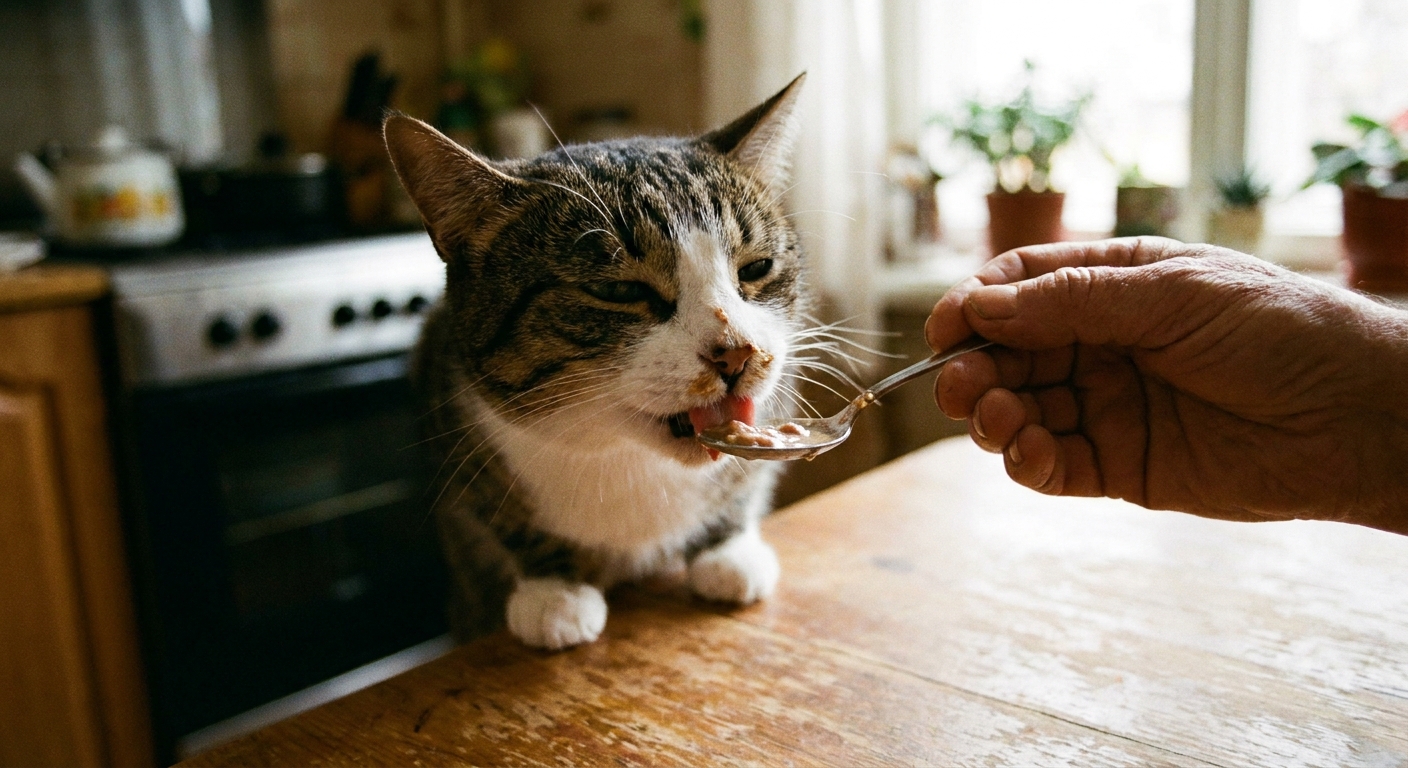
Method 1.5: Pill pockets and wraps
If your cat is suspicious of “mystery meatballs” but not ready for direct pilling, pill pockets and soft pill wraps can be a helpful middle step.
- Use a small amount. A thinner layer is harder to detect.
- Seal it completely. Any exposed edge invites chewing and spitting.
- Do a three-treat routine. Plain treat, medicated treat, plain treat. The follow-up treat encourages quick swallowing.
If your cat starts refusing the pocket entirely, do not keep pushing it. Switch methods before they blacklist the treat for life.
Method 2: Direct pilling
This is the technique I use most often for foster cats and for my own Clementine when she decides pill pockets are beneath her. The goal is simple: place the pill far enough back on the tongue that swallowing is the easiest option, then reward.
Step-by-step
- Position your cat. Many cats do best facing away from you on a stable surface. If your cat backs up or flails, go straight to the towel wrap section below.
- Support the head gently. Place your non-dominant hand over the crown of the head with your fingers resting just behind the cheekbones. You are guiding, not squeezing, and you should not be pressing down on the throat.
- Tilt the nose slightly upward. Not straight back, just enough that the lower jaw loosens.
- Open the mouth safely. If you can, keep your fingers outside the bite zone. You can use a pill giver, or use a finger on the lower lip or chin to encourage the jaw to open rather than putting your fingers near the front teeth.
- Place the pill far back on the tongue. Aim for the center, past the “hump” of the tongue. If the pill lands too far forward, many cats will spit it right back out.
- Close the mouth and watch for a swallow. Keep the mouth closed for 1 to 3 seconds. Some people find that a gentle throat stroke may help, and some cats will swallow after a soft puff of air toward the nose, but do not rely on any one cue. What matters is seeing a swallow.
- Reward immediately. Give a treat, a lickable treat, or a bite of wet food, whichever your vet says is allowed.
How to tell they swallowed
- A visible swallow or lip lick
- No pill seen on the tongue
- No “cheek storing” on one side of the mouth
Cheek storing is common. Some cats will pretend they swallowed, then walk away and spit the pill out like a tiny magic trick. If you suspect that, gently open the mouth again and check both cheeks.
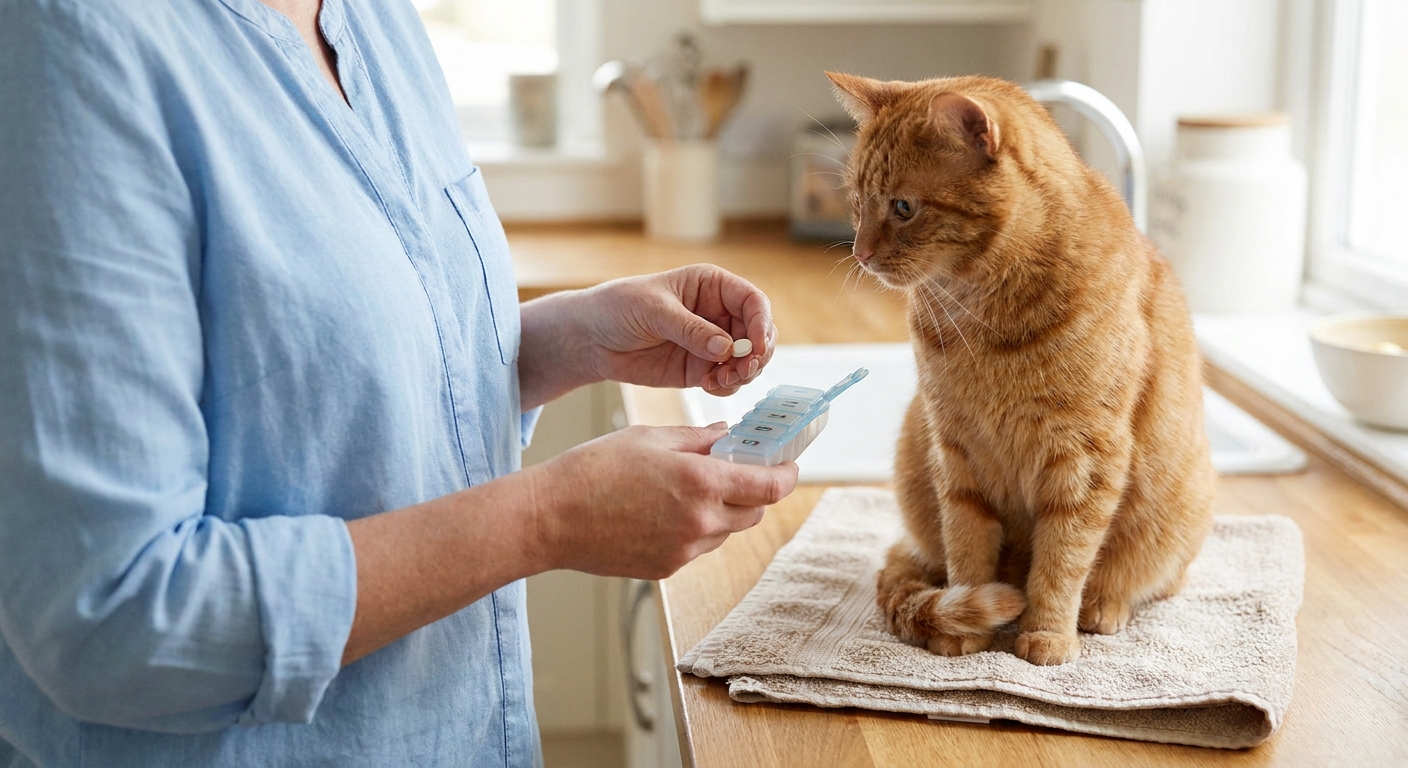
Towel wrap for wiggly cats
If your cat uses all four limbs like synchronized paddles, a towel wrap keeps everyone safer. This is not about pinning your cat down. It is about preventing scrapes and panic.
How to wrap
- Lay the towel flat on a table, bed, or the floor.
- Place your cat in the center with their head near one short end of the towel.
- Bring one side snugly over the body and tuck it under.
- Bring the other side over like you are swaddling, leaving only the head out.
- Keep the wrap firm but not tight. You should not restrict breathing. If your cat is panting, open-mouth breathing, or panicking, stop and reset.
Some cats do best when wrapped and held against your body. Others do better on a surface with you standing behind them. Try what feels safest for both of you.
The two-person option
If you have a helper, let one person focus on the wrap and gentle head support, while the other focuses on the medication. It often goes faster, which is kinder for everyone.
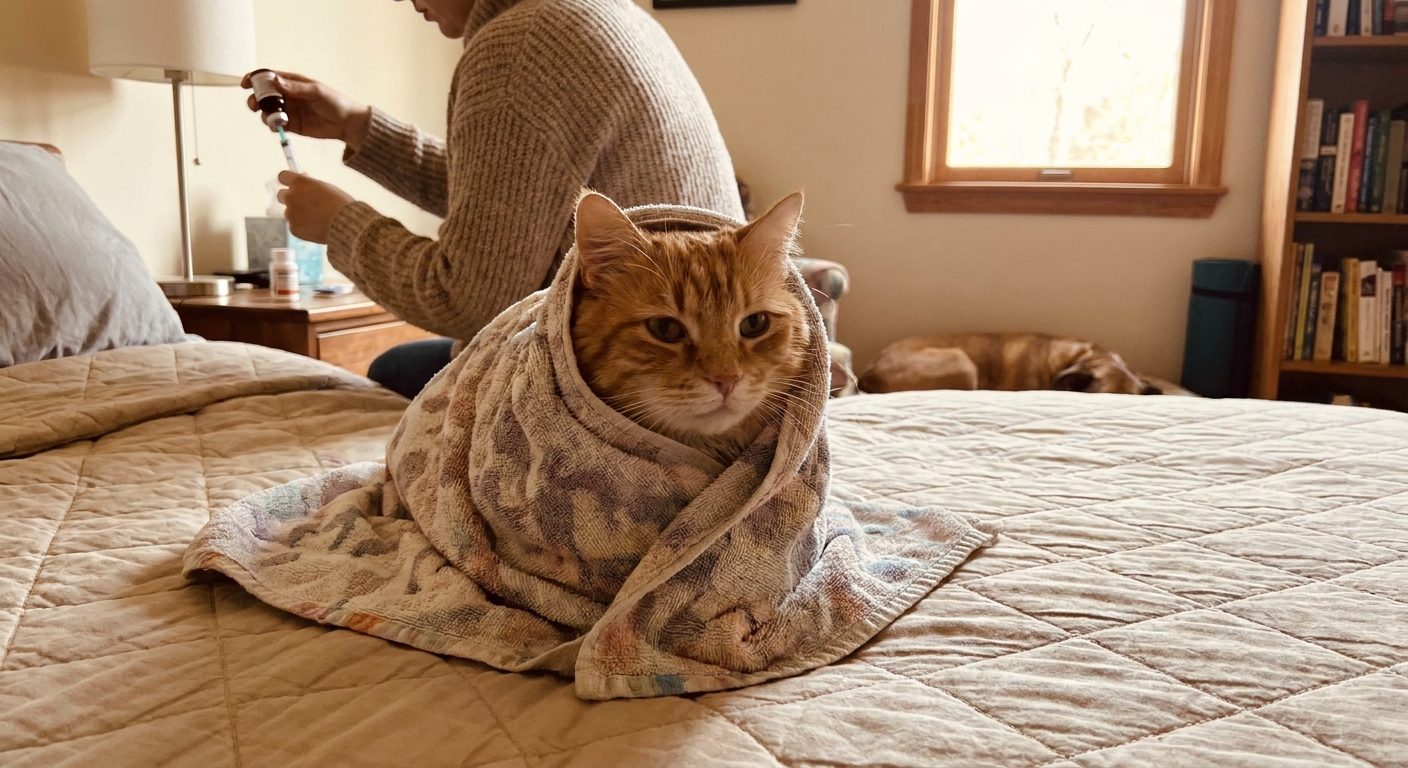
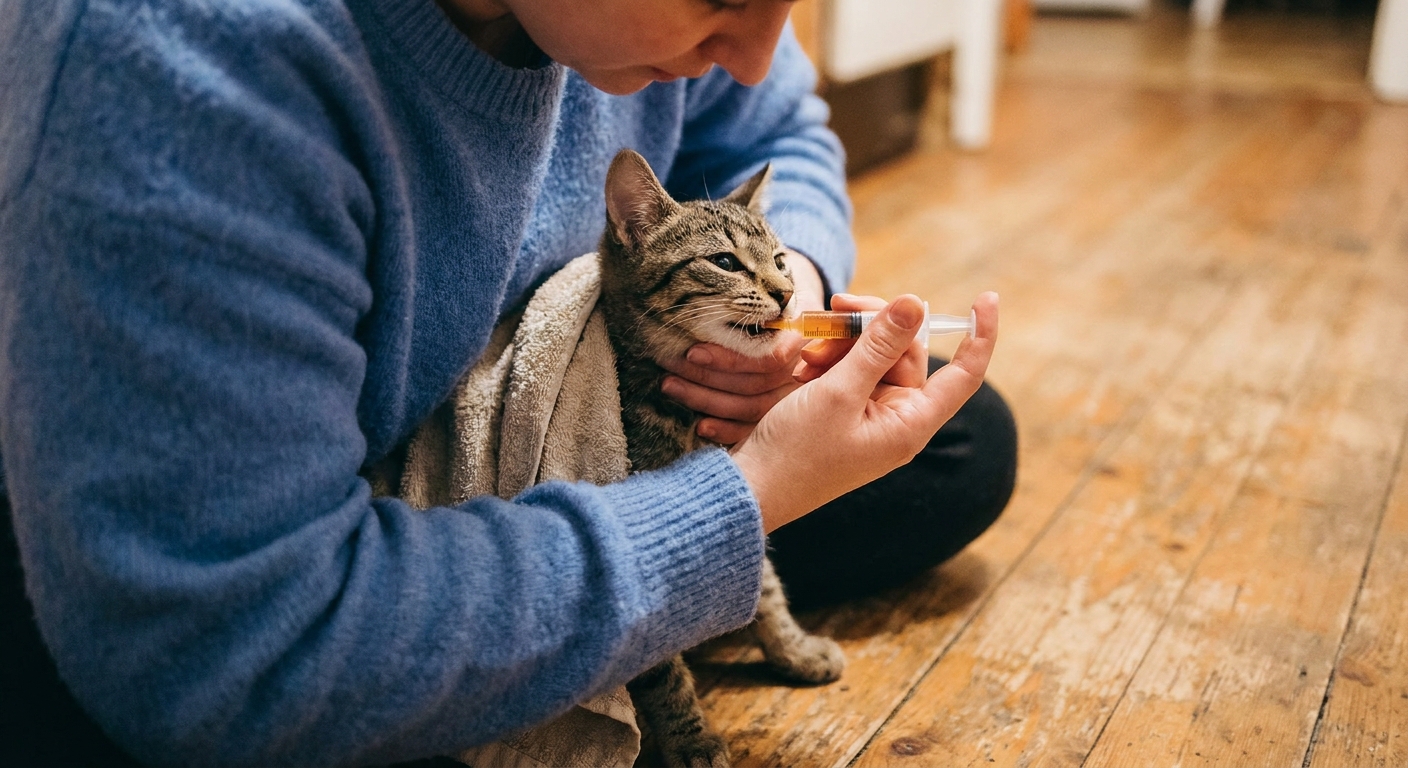
How to give liquid medicine
Liquid meds can be easier than pills, but only if they are given slowly and in the right spot. The key is to avoid shooting liquid straight to the back of the throat.
Step-by-step
- Draw up the exact dose using the oral syringe. Tap out bubbles so your measurement is accurate.
- Position your cat. Use a stable surface or a towel wrap if needed.
- Insert the syringe at the side of the mouth into the small gap behind the canine tooth, aiming toward the cheek pouch.
- Give slowly in small squirts. Pause between squirts to allow swallowing.
- Keep the head level. A level head helps your cat swallow normally and reduces the risk of mis-swallowing or aspiration. Speed and volume matter here more than force.
- Reward. A lickable treat can help with lingering taste, if your vet says it is allowed.
If your cat drools or foams after liquid medicine
This is often a taste reaction, especially with bitter meds. It looks dramatic, but it is not always dangerous. Offer a small amount of wet food or a lickable treat if allowed, and call your vet if the reaction is severe, prolonged, or accompanied by vomiting, weakness, or trouble breathing.
If they spit it out
This happens to the best of us. Waffles, my orange tabby, once spit a pill into my slipper with surgical precision. Here is what to do next.
Pause and assess
- Did you see the pill come out? If yes, you can often try again with the same pill, unless it is partially dissolved, broken, or your vet told you not to split or reuse it.
- Are you unsure? If you truly do not know whether a full dose was swallowed, do not automatically give another dose. Doubling can be dangerous for many medications. Call your clinic for guidance.
Common reasons and fixes
- Pill placed too far forward: Aim farther back on the tongue next try, or use a pill giver.
- Bitter taste: Ask your vet about a coated tablet, a flavored compounded option, or a different formulation.
- Too much struggle: Use the towel wrap, recruit a helper, and shorten the whole event.
- Dry swallow: If allowed, follow with a small amount of food. Some cats also do better with a tiny water chaser, but only with veterinary approval.
Do not keep escalating
If your cat is growling, open-mouth breathing, thrashing, or becomes difficult to handle safely, stop. A stressed cat is more likely to aspirate liquid, bite, or develop a long-term fear of being handled. Take a break and call your veterinary team to talk through alternatives.
When to ask for a different form
There is no prize for wrestling your cat twice a day for two weeks. If at-home dosing is turning into a daily battle, your clinic has options more often than people realize.
Ask about alternatives if:
- You cannot give the medication safely without being bitten or scratched
- Your cat is consistently spitting out pills or vomiting the dose
- Your cat stops eating because they now distrust food you offered with medicine
- The medication seems to cause intense drooling, gagging, or distress
- You are missing doses because the process is too stressful
Options your vet may offer
- Smaller pills or different tablet size
- Flavored liquid (often compounded)
- Chewable treats for some medications
- Capsules to mask bitterness
- Transdermal gel applied to the inner ear flap for certain drugs and situations (absorption can be variable, so it is not right for every medication)
- Long-acting injections when appropriate
Do not change the form yourself without guidance. Crushing, splitting, or mixing incorrectly can change how the medication works.
Safety notes I never skip
- Ask about dry pilling. Some medications can irritate the esophagus if they stick. Antibiotics like doxycycline are a classic example. If your vet says it is appropriate, follow pills with a small amount of food or a vet-approved chaser.
- Protect your fingers. Never put your fingers deep in a cat’s mouth if you are worried about being bitten. A pill giver is a safer tool for many households.
- Liquids go to the side and go slow. Aim for the cheek pouch, not the back of the throat.
- Stop for emergency signs. If your cat has trouble breathing, collapses, or turns blue or gray, seek emergency veterinary care.
After dosing
For the next 30 to 60 minutes, keep a casual eye on your cat.
- Often normal: a little drool from bad taste, a couple of lip licks, mild grumpiness, hiding to reset.
- Call your vet promptly: repeated vomiting, marked lethargy, facial swelling, hives, persistent gagging, or any breathing change.
Quick FAQ
Is it okay to crush my cat’s pill and mix it with food?
Sometimes, but only if your veterinarian or pharmacist says it is safe. Some pills are time-released, enteric-coated, or extremely bitter, and crushing them can be harmful or make them impossible to give.
My cat foamed after a pill. Is that an allergy?
Often it is a bitter taste response rather than a true allergy, especially if the pill started dissolving in the mouth. Still, call your vet if the foaming is intense, your cat vomits, develops facial swelling, hives, or seems weak or distressed.
How far back should I place the pill?
Far enough back that your cat’s tongue naturally moves it toward swallowing, typically past the middle “hump” of the tongue. Too far forward is a very common reason cats spit pills back out.
What if my cat refuses food after I hid medicine in it?
Stop using that food for medication and switch to a different technique. Food aversion can develop quickly in cats. Offer their normal meals separate from med attempts and ask your vet about other formulations if needed.
A final note from my foster-room days
Medication time gets easier when it is predictable: same spot, same calm routine, same tasty reward. Even if today felt messy, you did not fail. You are learning a skill, and your cat is learning they can get through it and still be safe.
If you want, tell me what kind of medication you are giving (pill vs liquid), how often, and what your cat does when you try. I can help you choose the least stressful method for your specific situation.